
WHITE PAPER Publication
Dr Liz Murray
March 2026
A Transformational Health Model to support the women's healt
WOMEN'S HEALTH CRISIS
Women in the UK wait an average of X years for diagnosis of chronic gynaecological conditions such as endometriosis. Diagnostic delay causes significant harm for patients, with secondary burden to the healthcare system. Most NHS metrics start after a diagnosis, but intervention is needed to prevent and avoid the delay.
WHY THE CURRENT SYSTEM FAILS
The current healthcare pathway unintentionally pushes patients through a predictable cycle of dismissal, fregmentation and decline.
Across the United Kingdom, patients with chronic and complex health conditions frequently experience prolonged diagnostic delays, fragmented care pathways, and insufficient support following diagnosis. These failures are not typically the result of individual clinician negligence but instead arise from structural limitations within current healthcare systems.
As a result, patients often navigate a prolonged and psychologically damaging process before receiving appropriate diagnosis, treatment, or validation of their symptoms.
The consequences are significant: worsening physical health, reduced quality of life, loss of employment, and deterioration in mental wellbeing.

DIAGNOSTIC DELAY CAUSING CLINICAL DECLINE
Diagnostic delay does not only affect physical health.
Patients frequently describe the experience of prolonged diagnostic uncertainty as deeply destabilising. Without validation or explanation for their symptoms, many begin to question their own perception of illness.
This can result in:
• Self-doubt and reduced confidence when seeking care
• Anxiety surrounding unexplained symptoms
• Feelings of dismissal within healthcare settings
• Deterioration in mental health
In some cases, patients may disengage from healthcare entirely, believing that further consultations will not result in meaningful support.
To address these systemic challenges, there is a need for a structured framework that:
- maps the stages patients move through during diagnostic delay
- provides clinicians with a tool to recognise patterns of decline
- enables patients to communicate their experiences more clearly
- supports earlier intervention and improved outcomes

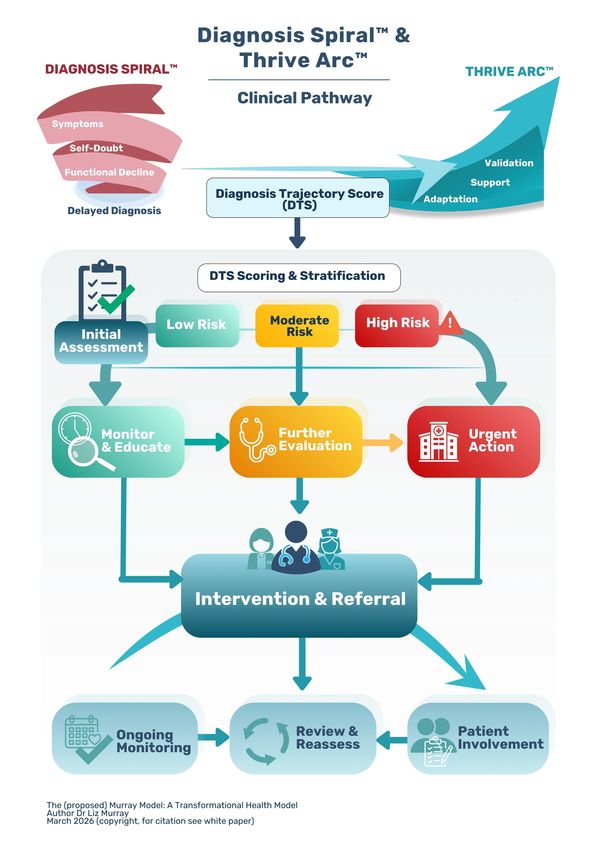
THE PROPOSED NEW MODEL: DIAGNOSIS SPIRAL, THRIVE ARC AND THE DTS SCORING TOOL. A FRAMEWORK TO SUPPORT RECOVERY IN WOMEN'S HEALTH
The Transformational Health Model is a conceptual and clinical framework designed to describe and intervene in the trajectory experienced by patients living with complex, poorly understood, or frequently dismissed health conditions.
The model proposes that patient outcomes are not solely determined by disease pathology but are strongly shaped by health system interactions, diagnostic delay, and support structures.
Two contrasting trajectories are defined:
• The Diagnosis Spiral (DS) – a pattern of clinical decline that occurs when symptoms are repeatedly normalised, dismissed, or fragmented across services.
• The Thrive Arc (TA) – a recovery-oriented trajectory that begins once validation, understanding, and structured support are introduced.
Together these trajectories form a dynamic framework describing patient movement between decline and recovery within healthcare systems.
CITATION

CITATION
This white paper may be cited, shared, and referenced for educational, clinical, and policy purposes, provided appropriate attribution is given.
Suggested citation:
Murray, E. (2026). The Diagnosis Spiral and Thrive Arc: A Transformational Model for Addressing Diagnostic Delay in Women’s Health.
REPRODUCTION DISCLAIMER
No part of this publication may be reproduced, modified, or distributed for commercial purposes without prior written permission from the author.
© 2026 Dr Liz Murray. All rights reserved.
Intellectual Property
The concepts, frameworks, and models described within this document—including the Diagnosis Spiral™, Thrive Arc™, and Diagnosis Trajectory Score (DTS)—are the intellectual property of the author and are protected under applicable copyright and intellectual property laws.